
Industry partnerships ensure graduates have skills for next-generation jobs




Microsoft
Find out more about Microsoft's smart technology resources for higher education
Partnerships with industry are vital for universities wanting to introduce relevant, innovative programmes that prepare their graduates for the future of work.
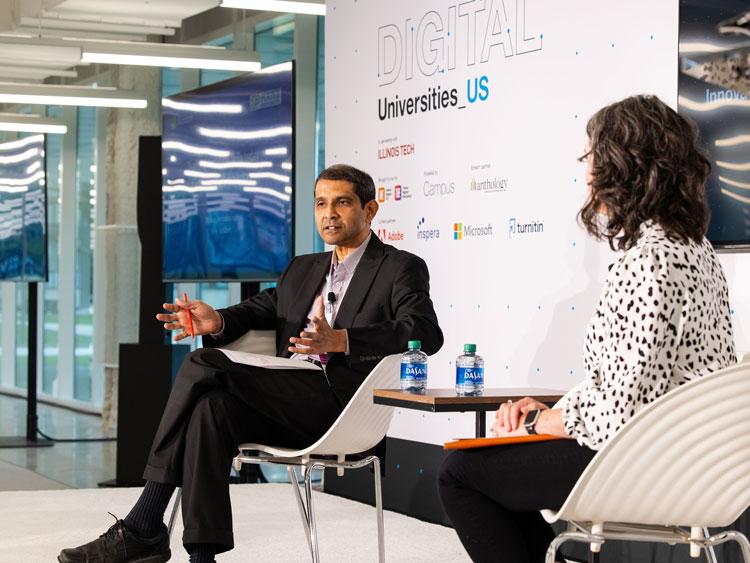
Speaking on a panel at THE Digital Universities US 2023, Ragu Athinarayanan, a professor of smart manufacturing and industrial informatics at Purdue University, said: “Industry partners were our eyes and ears to what trends were happening in industry so that we could bring them back to the classroom.” The session, titled “Teaching technical skills today for tomorrow's workplace”, was held in partnership with software giant Microsoft.
Before the pandemic, US industries were already evolving to take advantage of the Fourth Industrial Revolution. This revolution, which is characterised by increasing automation and data utilisation, “has been enabled by such things as the Internet of Things, big data, artificial intelligence, machine learning and data visualisation,” Athinarayanan said. The pandemic accelerated the manufacturing sector’s digital transformation.
Athinarayanan developed a new undergraduate degree at his university, focusing on creating the next generation of manufacturing graduates, and set up the Department of Energy’s Smart Manufacturing Innovation Center.
“Our number one goal was to contribute to the productivity and competitiveness of US manufacturing,” he said. “Goal number two was to create a sustainable pipeline of next-generation manufacturing graduates who can not only contribute to but accelerate the digital transformation of US manufacturing industries.”
However, higher education programmes tend to focus on graduate courses rather than undergraduate education. Because of this, Athinarayanan could not benchmark Purdue University’s new degree against what other institutions in the US or Europe were doing. So, he took an “unorthodox approach”, he said. “It was driven by industry. They were a critical, integral part of programme development.”
The programme, which began last year, cost $15 million (£12 million) to develop, and industry contributed about half of the funds because “they could see the importance in creating a programme like this”, he said. To bring together stakeholders, it is important to leverage the power of networks, said Athinarayanan, who partners with the likes of Microsoft, Caterpillar and the US Department of Energy.
He cautioned that those interested in starting new programmes and centres require buy-in from both industry and their institutions, and must be aware that the two sectors move at different paces. Additionally, they must balance the need to respond to industry trends and engagement with the rigours of research and teaching scholarship.
Athinarayanan also advised that institutions with internal and stakeholder buy-in should take the risk and begin a new programme, rather than piloting courses in a piecemeal fashion. “My recommendation is to take a holistic approach. Take the leap of faith – it does take effort, time and budget” but that is better than getting stuck in “pilot purgatory”, with small projects scattered throughout an institution, he concluded.
about Microsoft for higher education.
